Are Digital Wedding Invitations Acceptable? Modern Etiquette Explained
Yes, digital wedding invitations are acceptable. Learn when they work best, when paper may be better, and how to send an elegant digital invitation properly.
Are Digital Wedding Invitations Acceptable?
Yes, digital wedding invitations are acceptable for modern weddings. They are no longer limited to casual celebrations or couples trying to reduce costs. A thoughtfully designed digital invitation can feel elegant, personal, and entirely appropriate—even for a formal wedding.
What matters is not whether the invitation arrives on paper or through a link. What matters is whether it reflects the wedding, clearly identifies who is invited, gives guests the information they need, and makes responding easy.
Digital will not be the perfect choice for every guest or every event, however. A very traditional wedding, guests with limited internet access, or relatives who deeply value printed stationery may call for paper invitations or a hybrid approach.
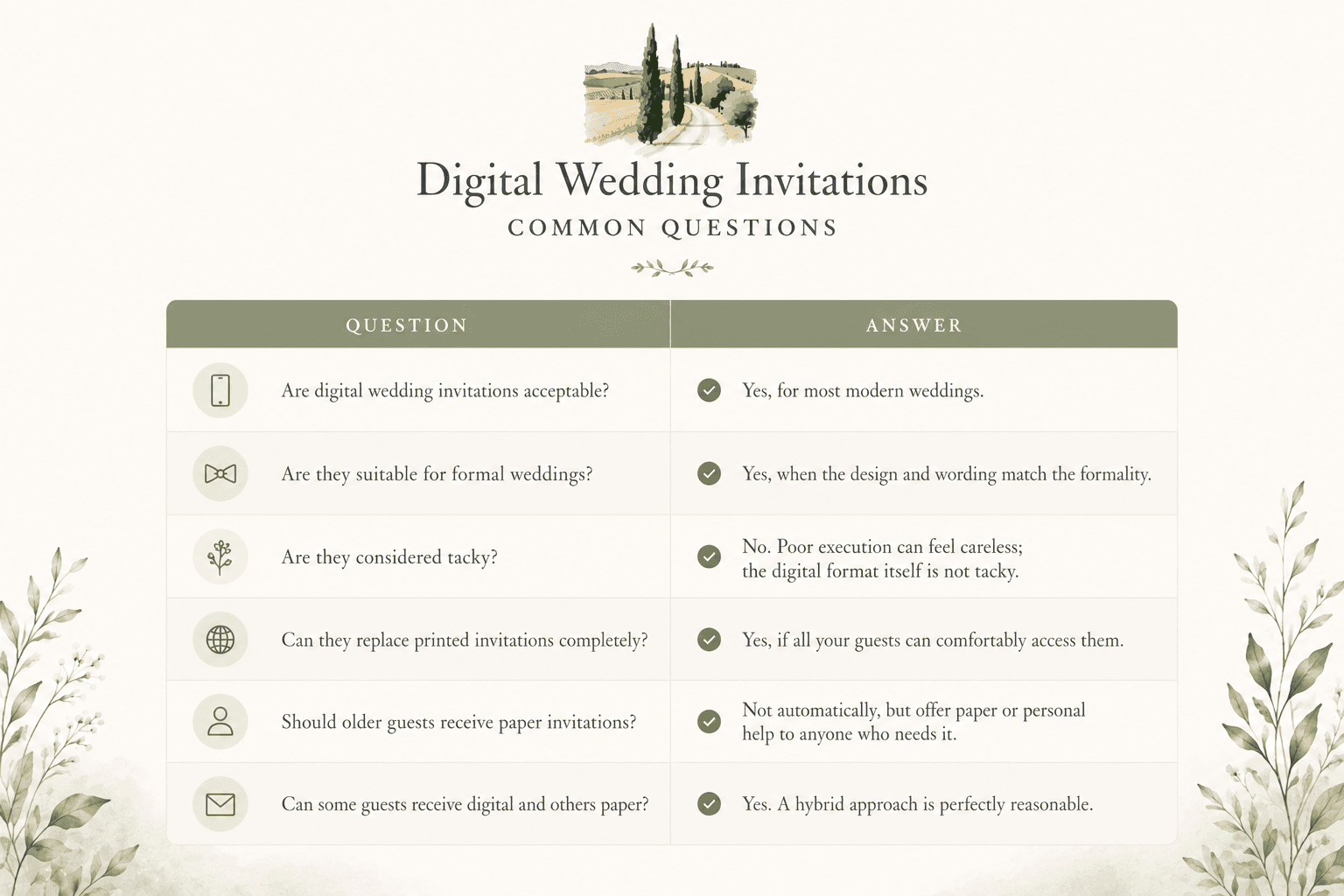
The short answer
Why digital wedding invitations are now accepted
Weddings have changed, and the way guests communicate has changed with them. Travel arrangements, venue maps, hotel bookings, group updates, and RSVPs are already handled online for many celebrations.
A digital invitation brings that information together instead of asking guests to keep a card, search through messages, and respond through a separate channel.
Couples increasingly choose digital invitations because they offer:
- Immediate delivery
- Built-in RSVP collection
- Easier guest-list management
- Direct map and accommodation links
- Space for schedules, galleries, and FAQs
- Faster corrections and event updates
- No printing or postage delays
- One invitation link guests can revisit
- Support for multilingual celebrations
These are not merely technical conveniences. They can make the guest experience clearer and more considerate.
Are digital wedding invitations tacky?
Digital wedding invitations are not inherently tacky. An invitation feels careless when it looks rushed, uses generic wording, arrives without context, or leaves guests confused about whether it is the real invitation.
A digital invitation feels intentional when it has:
- A design suited to the wedding
- The couple's names and a warm invitation message
- Clear date, time, and venue information
- Personalized guest addressing
- A straightforward RSVP experience
- Consistent typography and imagery
- No intrusive advertisements
- No requirement for guests to install an app
The real distinction is not digital versus paper. It is thoughtful versus careless.
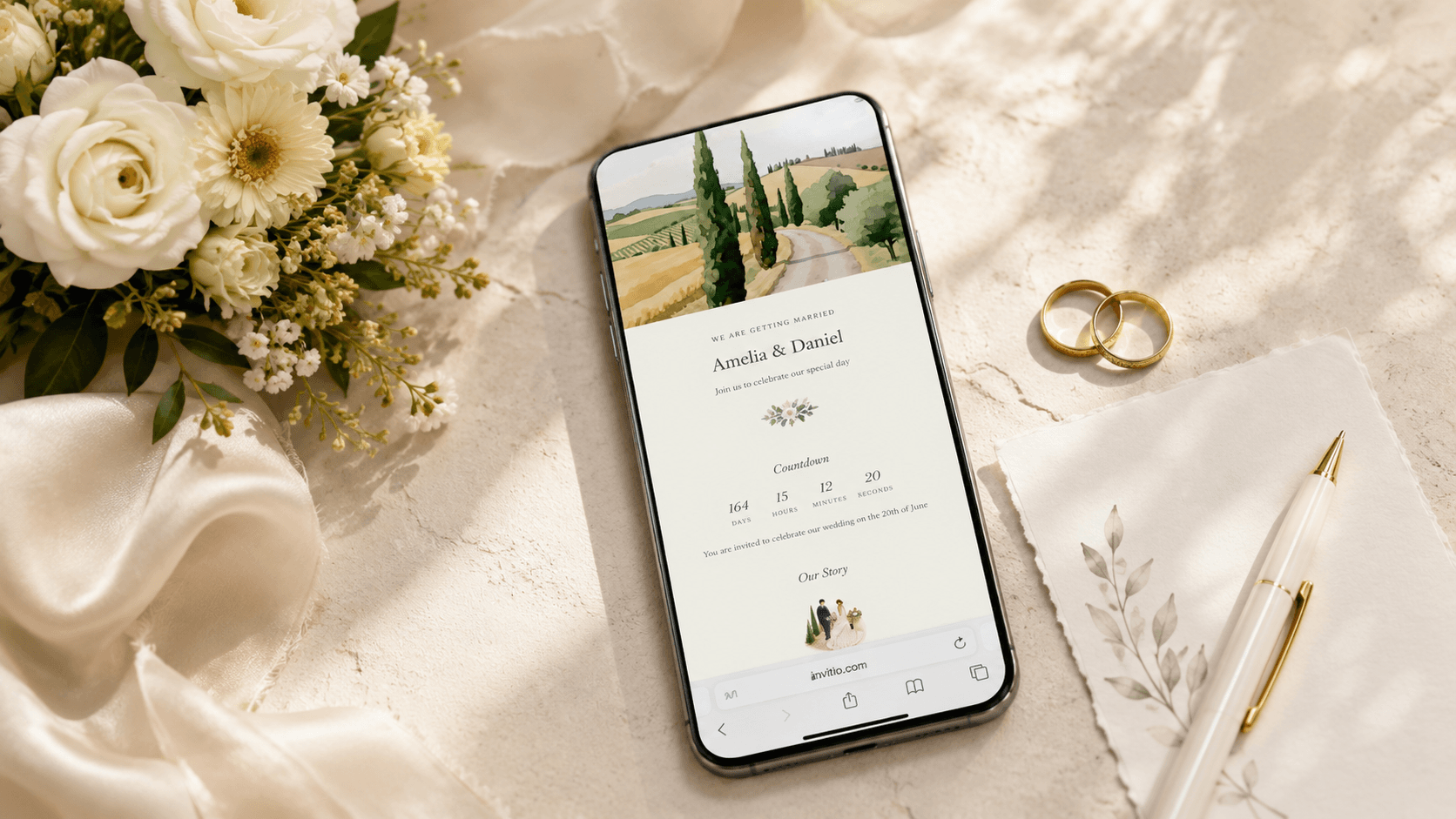
 An elegant personalized digital wedding invitation shown on a smartphone
A considered layout, personal wording, and clear event details can make a digital invitation feel every bit as intentional as printed stationery.
When digital wedding invitations work especially well
Digital invitations are an excellent fit when convenience and clear communication are important.
Weddings with international guests
Postal delivery across several countries can be slow, expensive, or unreliable. A digital invitation reaches everyone quickly and gives traveling guests immediate access to hotel, map, schedule, and contact information.
Multilingual weddings
For families who speak different languages, a digital format gives you more flexibility than a small printed card. You can write the invitation in the language that best serves your guests or create separate versions where appropriate.
Invitlo invitations can be written in any language, making them particularly useful for multicultural and international celebrations.
Destination weddings
Destination wedding guests need more than a date and venue. They may need flight guidance, hotel options, transportation details, a multi-day schedule, and local recommendations. A structured digital invitation keeps that information accessible from the same link.
Weddings planned on a shorter timeline
Digital delivery removes printing, proofing, shipping, and postal time. This does not mean you should delay inviting guests, but it can prevent production logistics from creating an additional delay.
Couples who want simpler RSVP management
Instead of collecting replies through messages, calls, mailed cards, and spreadsheets, hosts can direct guests to one RSVP flow. This reduces manual work and makes unanswered invitations easier to identify.
Environmentally conscious celebrations
Digital invitations avoid paper, envelopes, test prints, and postal delivery. Some couples still choose printed day-of pieces—such as menus, place cards, or programs—while keeping the invitation itself digital.
When printed invitations may still be the better choice
Digital invitations are acceptable, but that does not make paper obsolete. Printed stationery may be the stronger choice when:
- Your wedding follows highly traditional family or cultural expectations
- The physical invitation is an important keepsake
- Several guests have limited internet access
- Your guests are unlikely to recognize a digital link as the official invitation
- Hand-finished stationery is a central part of the wedding's design experience
- Your religious or ceremonial tradition expects a physical invitation
If you love printed stationery, choose it because it matters to you—not because digital invitations are supposedly improper.
The hybrid approach: digital and paper together
You do not have to make one format work for every guest. A hybrid approach may be the most thoughtful option.
For example, you could:
- Send digital invitations to most guests
- Provide printed invitations to relatives who prefer them
- Send a printed announcement with a link or QR code to the complete invitation
- Use printed invitations but collect RSVPs digitally
- Use digital invitations and print a few keepsake copies for yourselves and close family
Try to send both versions at approximately the same time so no group feels like an afterthought. Keep the wording, visual identity, dates, and RSVP deadline consistent across formats.
 A coordinated printed invitation and matching digital invitation displayed together
A hybrid approach preserves the tactile experience of paper while giving guests the convenience of digital details and RSVP.
Digital wedding invitation etiquette
Going digital does not remove invitation etiquette. It changes how you apply it.
1. Make it obvious that this is the official invitation
Guests should not mistake your invitation for a save-the-date, mood board, or casual event announcement.
The message used to share it should be explicit:
We're delighted to invite you to celebrate our wedding. Please open your personal invitation below for the full details and RSVP.
A clear title such as “John & Sara's Wedding Invitation” also helps.
2. Personalize the invitation
Address the invited guest or household by name. Personalization communicates care and removes uncertainty about partners, children, and plus-ones.
Avoid dropping an unexplained generic link into a large group conversation. Guests should know that the invitation is intended for them.
3. Match the design to the wedding
Your invitation creates the first impression of the celebration. A formal wedding deserves a polished design, considered typography, restrained colors, and wording consistent with that level of formality.
A casual beach wedding can use a lighter voice and more relaxed visuals. Digital does not dictate the style—the event does.
You can browse Invitlo's wedding invitation templates, including Classic Wedding, Floral, and Tuscany Homerun.
4. Include all essential information
A digital invitation still needs the same core details as a printed one:
- Couple's names
- Wedding date
- Ceremony time
- Venue and location
- Reception information
- RSVP instructions and deadline
- Dress code, when applicable
It may also include accommodation, transportation, plus-one rules, children policies, and additional events.
5. Send it through a familiar channel
Use a communication channel your guests already recognize, such as email, WhatsApp, or a direct message. The best channel depends on your family, region, and normal communication habits.
When sharing by message:
- Introduce the link with a warm sentence
- Use the guest's name
- Identify both members of the couple
- Explain that the link contains the official invitation
- Mention the RSVP deadline
- Avoid URL shorteners that may look suspicious
6. Do not expose your guest list
Do not place guests in a large group chat simply to distribute invitations. It exposes contact details, encourages unrelated replies, and makes the invitation feel like a broadcast.
Send each invitation privately or use a platform designed for individual guest links and response tracking.
7. Make responding easy
Guests should be able to open the invitation and RSVP without creating an account, downloading an app, or navigating a complicated form.
Only request information you actually need, such as attendance, meal selection, allergies, or participation in additional events.
8. Account for guests who need assistance
Do not assume that age alone determines digital comfort. Some older relatives use digital tools confidently, while some younger guests may overlook email or avoid unfamiliar links.
Check whether each guest can access the invitation. For anyone who cannot, offer a printed version, call them personally, or record their RSVP on their behalf.
9. Confirm delivery and follow up thoughtfully
Digital invitations can avoid postal loss, but messages can still be missed or filtered. Monitor unopened invitations, bounced emails, and incomplete responses.
If someone has not opened the invitation, follow up personally:
Hi Maya, we wanted to make sure our wedding invitation reached you. I am sending the link again here in case the first message was missed.
Do not assume that silence means the guest is declining.
10. Preview everything before sending
Check every name, date, time, address, map link, image, and RSVP option. Open the invitation on both a phone and a computer, then complete the RSVP as though you were a guest.
How to make a digital invitation feel more personal
The most common concern about digital invitations is not etiquette—it is emotional value. Couples worry that a link might feel less meaningful than an envelope.
You can preserve the sense of occasion by adding:
- A thoughtful opening message
- A favorite engagement photograph
- A short version of your story
- A design connected to the venue or wedding theme
- Carefully chosen music, if optional and unobtrusive
- Personalized guest names
- A genuine closing note
- A consistent design across the invitation and wedding day
The sharing message also matters. A personal sentence sent directly to the guest feels very different from forwarding a bare link.
Can you use digital invitations for a formal or black-tie wedding?
Yes. The formality comes from the design, wording, guest experience, and event—not the material on which the invitation is delivered.
For a formal digital invitation:
- Use full names and formal wording
- Choose refined typography and a restrained color palette
- Avoid excessive animation or playful effects
- Clearly state the dress code
- Personalize each guest or household
- Keep navigation simple
- Use high-quality photographs and graphics
- Test the invitation carefully before sending
If printed stationery is expected within your family or social circle, a hybrid format can preserve that tradition while still providing digital RSVP and event information.
When should digital wedding invitations be sent?
Digital invitations should not be sent at the last minute simply because delivery is instant. Guests still need time to arrange travel, childcare, accommodation, and time away from work.
As a general planning framework:
- Send save-the-dates well in advance, especially for destination weddings
- Send the full invitation several weeks before the wedding
- Set the RSVP deadline early enough to confirm numbers with your venue and suppliers
- Leave time to contact guests who have not responded
Your exact timeline should follow the requirements of your venue, caterer, planner, and destination—not a universal rule copied from another wedding.
Common mistakes to avoid
- Sending only a bare link with no personal message
- Making guests create an account to view or respond
- Using a design that feels unrelated to the wedding
- Forgetting to specify who is invited
- Hiding the RSVP deadline
- Putting everyone into a group chat
- Assuming every message was received
- Including unconfirmed information
- Using unreadable text or oversized media
- Forgetting to test the invitation on mobile
- Treating guests who prefer paper as inconvenient
Frequently asked questions
Is it rude to send a wedding invitation by text?
No, provided text or WhatsApp is a normal communication channel for your guests and the message is personal. Introduce the invitation warmly, identify the couple, and make it clear that the link is the official wedding invitation. Avoid sending a bare URL or distributing invitations through a group chat.
Is it acceptable to email wedding invitations?
Yes. Use a recognizable sender name, a clear subject line, and a direct link to the invitation. Check for bounced or unopened emails and follow up through another channel when necessary.
Will older guests be offended by a digital invitation?
Some may prefer paper, but age alone is not a reliable guide. Consider each guest individually. If a relative values printed invitations or is uncomfortable online, offer them a printed version or speak with them personally.
Can we send digital invitations to some guests and paper invitations to others?
Yes. This is a practical hybrid approach. Keep both versions equally thoughtful and send them at roughly the same time, with the same event information and RSVP deadline.
Do digital invitations work for destination weddings?
They work particularly well for destination weddings because guests can revisit travel details, hotel links, venue maps, transportation schedules, and multi-day itineraries from one place.
Are digital invitations suitable for luxury weddings?
Yes. A custom or carefully selected design, formal wording, personal addressing, high-quality imagery, and a seamless RSVP experience can make a digital invitation appropriate for a luxury celebration.
Should we still print anything for the wedding?
Only if it serves your celebration. You may still want printed menus, place cards, ceremony programs, signage, or a keepsake invitation. Choosing a digital invitation does not require the entire wedding to be paperless.
The verdict
Digital wedding invitations are acceptable. More importantly, they can be elegant, practical, personal, and better suited to the way your guests communicate.
The right decision depends on your wedding and your audience. Choose digital when it makes the experience clearer and easier. Choose paper when the physical object or tradition matters. Use both when different guests have different needs.
Whichever format you choose, thoughtfulness is the etiquette that matters most.
Create an invitation that feels worthy of the occasion
With Invitlo, you can create a polished digital wedding invitation, write it in your preferred language, add event details and locations, collect RSVPs, and manage guests through one shareable link.
Explore the wedding invitation templates and design your invitation before you publish.
Create your wedding invitation →
Invitlo uses simple one-time pricing per event, with no subscription required.